Every critical function in a modern vehicle, from torque delivery in electrified powertrains to low-latency ADAS sensing, depends on the quality of its nervous system. That system is built on automotive cable assemblies. As vehicles pack more sensors, higher voltages, and faster in-vehicle networks into tighter spaces, the design window narrows. Choices that once felt routine, conductor alloys, dielectric materials, shielding topologies, and connector interfaces, now carry measurable impacts on signal integrity, thermal performance, EMC, and lifecycle reliability.
In this analysis you will learn how to evaluate trade-offs that matter at production scale. We will examine when to specify copper versus aluminum, where twisted pair, coax, or single-pair Ethernet are appropriate, and how impedance control and shielding strategies mitigate crosstalk and radiated emissions. We will cover insulation and jacket polymers for temperature, chemical exposure, and flexibility, along with sealing, overmolding, strain relief, and bend radius constraints that drive DFM. You will also see common failure modes, fretting, wicking, and galvanic mismatch, and the test methods that expose them, including continuity, hipot, TDR, and vibration screening. The goal is to give you practical criteria to engineer robust, compliant, and cost-aware automotive cable assemblies.
The Evolution of Automotive Cable Assemblies
From basic looms to high-voltage, data-rich assemblies
Automotive cable assemblies began as short looms for ignition and lighting, with few connectors and straight runs. Feature growth added power features and ECUs, which drove adoption of CAN and LIN to limit copper. Electrification and ADAS expanded demands again, introducing 400 to 800 volt propulsion paths and low-noise data backbones like automotive Ethernet. The market mirrors this evolution, with assemblies forecast near a 7 percent CAGR from 2025 to 2033 and high-voltage cables reaching 25.3 billion dollars by 2030.
Technology reshaping design and production
Aluminum conductors are increasingly specified to cut mass, delivering about 61 percent of copper conductivity at roughly 30 percent of the weight. Multi-layer insulation stacks such as XLPE and EPR enable up to 1,000 V DC operation and higher thermal and fluid resistance. Integrated power and data sub looms support compact ADAS architectures, while disciplined electromagnetic compatibility practices contain crosstalk and noise. Manufacturing is advancing through automated wire prep, vision-checked connector mating, and AI-guided routing, trends summarized in these advances in automotive cable manufacturing. For design teams, apply correct gauge selection for voltage drop, bend radius control, strain relief, and robust wire management using sleeves, tubing, and ties.
Tec-Stop’s role in practical innovation
Tec-Stop applies these advances with calm, precise execution. We deliver custom wiring solutions and control panel assemblies that balance weight, thermal limits, and electromagnetic compatibility through segregated routing, shield termination, and validated crimp pull-force data. Our ISO 9001 approach emphasizes clear drawings, consistent builds, and traceable materials, supported by continuity checks and high-voltage insulation testing. In recent EV programs we have reduced harness mass via selective aluminum adoption and shortened branches through localized electronics, while preserving service loops and standard interfaces.
Materials and Technologies Shaping the Future
Lightweight and eco-friendly materials
Lightweight, low carbon materials are moving into automotive cable assemblies. Thermoplastic elastomers provide recyclable jacketing with chemical and abrasion resistance, often displacing PVC in interior looms. Cross linked polyethylene insulation maintains dielectric strength and bendability at elevated temperatures in EV battery and inverter zones. Bio based compounds are entering jackets and fillers with reported renewable content above 40 percent and meaningful cradle to gate CO2 cuts, summarized in this review of eco friendly, halogen free cable materials. These choices reduce harness mass, improve routing, and support halogen free specifications.
New manufacturing technologies for efficiency
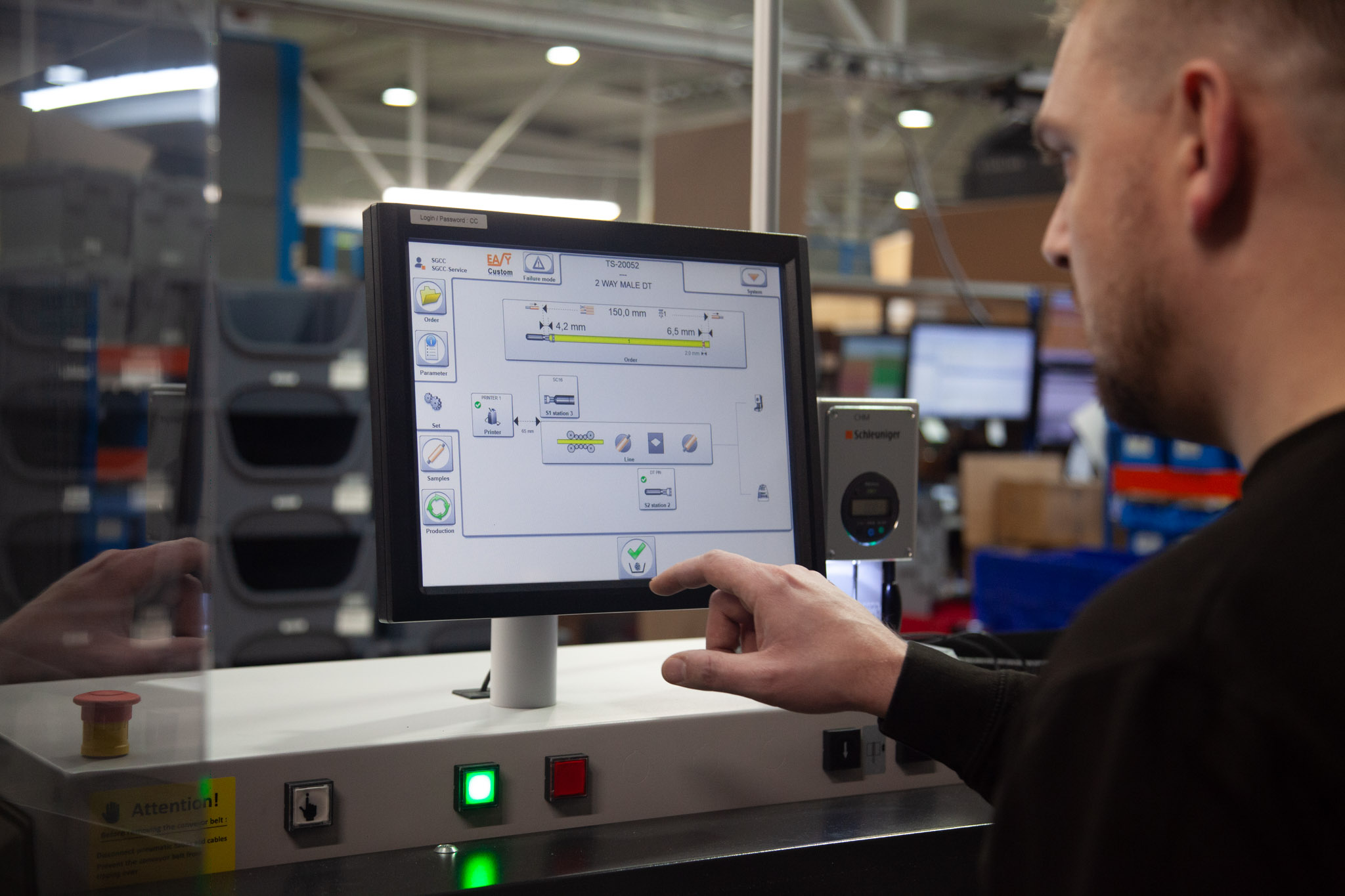
Manufacturing is evolving in parallel to handle electrification and ADAS density. Automated cut, strip, crimp, and tinning cells with crimp force monitoring stabilize terminations and reduce rework. Over molding for strain relief and ingress protection, plus ultrasonic welding of splices and shields, improves durability in high vibration zones. Inline continuity, hipot, and network checks tied to serialization raise first pass yield and enable traceability. With high voltage cable demand projected at USD 25.3 billion by 2030 and the overall market growing near 7 percent CAGR, targeted automation reduces labor exposure and lead time risk. SMT and AOI on control panels align electronics and cable quality.
Tec-Stop’s approach to cutting-edge technologies
Tec-Stop applies these advances with a practical, quality first lens. We qualify TPE, XLPE, and PP blends by zone of use, then document bend radius, clamp spacing, and derating in the build pack. Our cells use validated applicators, documented pull force data, and closed loop crimp monitoring; over molding and potting are tooled for IP67 to IP69K as required. Each harness is verified with 100 percent electrical test and labeled for full traceability. For engineering teams, the result is consistent wiring solutions that drop into vehicle builds smoothly, cut debug time, and give confidence in every connection.
Understanding Compliance and Industry Standards
Why compliance matters for safety and performance
Compliance is the first control on risk in automotive cable assemblies. Standardized conductor, insulation, and termination criteria reduce failure modes such as thermal softening, insulation cracking, and micro-arcing that can trigger intermittent faults or fires. This is amplified in EV platforms where high-voltage looms and compact routing elevate stress levels, and the global high-voltage cable market is projected to reach USD 25.3 billion by 2030, signaling wider exposure if quality drifts. ADAS and data-rich networks are equally sensitive to impedance and noise, so consistent shielding, drain continuity, and strain relief maintain signal integrity. Practical controls include avoiding sharp bend radii, applying sleeves and tubing in wear zones, and specifying gauge with margin for duty cycle and ambient temperature. For engineering teams, referencing accepted automotive wiring standards for safety and reliability keeps decisions traceable and auditable.
Key standards and how Tec-Stop applies them
IATF 16949 and ISO 9001 anchor Tec-Stop’s quality framework, from APQP inputs to corrective action discipline, so builds are consistent across batches. On the product side, ISO 6722 and SAE J1128 guide conductor classes, insulation materials, and thermal ratings for low-voltage circuits, while IPC/WHMA-A-620 defines workmanship, inspection, and acceptance criteria for terminations and assemblies. We apply 100 percent continuity checks, crimp-height SPC, and pull testing against terminal supplier data. For high-voltage harnesses, hipot and insulation resistance tests are paired with thermal shock and vibration profiles typical of -40 to 125 C environments. Traceability down to lot-level wire and terminals supports rapid containment, which shortens OEM debug cycles and reduces warranty exposure.
Standards as a driver of innovation and competitiveness
Standards do not slow innovation, they create safe boundaries for it. Common definitions for conductor temperature classes, creepage and clearance, and acceptance criteria let engineers introduce lighter materials and denser packaging without compromising safety. This discipline accelerates homologation across markets and supports global sourcing, a practical edge as the cable assembly segment is forecast to grow at roughly 7 percent CAGR from 2025 to 2033, with the U.S. harness segment tracking about 5 percent YoY. Actionable steps include building a requirements-to-test compliance matrix at concept freeze, aligning DV and PV plans to IPC/WHMA-A-620 calls, and engaging suppliers early on gauge, shielding, and sealing choices. With this foundation, Tec-Stop helps OEMs launch new architectures with confidence and compete globally.
The Rising Importance of Control Panels
Role in automotive manufacturing
Control panels are the backbone of automotive plants, coordinating robots, conveyors, vision stations, testers, and traceability. PLCs, safety relays, and variable frequency drives regulate cycle time, quality checks, and safe stops, while remote monitoring shortens diagnostics, as outlined in controls for automotive manufacturing. As electrification accelerates, the high voltage cable market is projected at 25.3 billion by 2030, and automotive cable assemblies are forecast to grow 7 percent CAGR from 2025 to 2033. Guidance: segregate low level I O from high power, specify shielded VFD cable, and use single point grounding to protect measurements and networks.
Electronics integration, from HMI to analytics
Electronics integration is reshaping panels with HMIs, Ethernet based motion, and IIoT sensors streaming condition data to edge analytics. Digital HMIs replace hardwired buttons, enabling recipes, multilingual prompts, and guided troubleshooting; deterministic networking and smart sensors tighten torque, crimp force, and continuity monitoring, aligning with the expanding role of SMT assemblies in EV electronics. Remote dashboards turn alarms into actionable maintenance tasks. Standardize tag naming, maintain versioned I O maps, and enable secure remote support with role based access to speed resolution and reduce change risk.
How Tec Stop balances innovation and reliability
Tec Stop pairs new capability with proven wiring practice. Inside each panel, we select wire gauge to the load, apply sleeves, tubing, and ties, avoid sharp bends, and build in strain relief to reduce failure. We perform 100 percent continuity and hipot tests, then simulate operation under load before shipment. Ferrule labeling, maintained torque specs, and documented change control keep service efficient and consistent. We design for maintainability with modular terminations and keyed connectors, helping OEMs achieve repeatable startup and throughput.
Future Trends in the Automotive Wiring Market
Market trajectory and drivers
Forecasts point to sustained expansion as vehicles add voltage, sensing, and data bandwidth. The wiring harness market was estimated at USD 50.09 billion in 2023 and is projected to reach USD 63.00 billion by 2030 at 3.4 percent CAGR, with Asia Pacific holding 45.8 percent share, according to Grand View Research. Other analysts see a steeper curve, projecting USD 119.31 billion by 2033 at roughly 8 percent CAGR, reflecting differing scope and EV weighting, per FMI Reports. Segment views align directionally with global estimates that automotive cable assemblies will grow near 7 percent CAGR from 2025 to 2033, while high voltage cables could reach about USD 25.3 billion by 2030. Electrification, ADAS integration, and lightweighting remain the primary demand catalysts. Practically, 800 volt EV platforms are increasing shielded high voltage runs and high-speed data pairs, which elevates thermal management, EMI, and sealing requirements at the assembly level.
Automation reshapes build methods
Historically, cable and harness assembly relied on manual routing and termination, which constrained repeatability at scale. New connector families and fixture concepts are optimized for robotic handling, enabling automated cut, strip, crimp, and insertion, along with AI-guided connector mating in complex cavities. Digital work instructions, MES integration, and in-line verification such as crimp force monitoring, laser wire marking, and vision-based pin presence checks are reducing variation. As SMT content grows in EV power electronics, automated optical inspection and traceability at the board-to-harness interface are becoming standard acceptance gates. Manufacturers that design for automation, standardize interfaces, and modularize looms by vehicle zone can shorten changeovers and improve first pass yield.
Tec-Stop’s outlook and actionable moves
Tec-Stop expects steady growth and higher complexity to reward disciplined engineering. We are prioritizing flexible automation cells for high runners, ultrasonic splicing for aluminum and copper hybrids, and 100 percent electrical testing with HV isolation checks for EV assemblies. Our approach emphasizes design for manufacturability, consistent wire gauge selection, controlled bend radii, and robust strain relief to minimize field risk. For OEMs, we recommend early DFM collaboration, specifying automatable connectors, aligning on test coverage for high voltage and data integrity, and using modular subassemblies to manage late-stage change. This roadmap supports dependable builds, clearer communication, and confidence in every connection.
Key Findings and Market Implications
Recap of major insights
Automotive cable assemblies are entering a scale and complexity phase driven by EV voltage levels, ADAS bandwidth, and stricter reliability expectations. The broader cable assembly market is projected to reach USD 292.6 billion by 2031 at a 6.2 percent CAGR, indicating sustained investment across transportation and industrial segments global cable assembly market forecast to USD 292.6 billion by 2031. Within automotive, high-voltage content is accelerating as OEMs shift to 400 to 800 V architectures, with a growing share of new harness investment aimed at high-voltage and data communication needs automotive wires and cable materials trends including HV focus and ADAS complexity. Production technology is also moving, where robotic harness assembly, laser-welded terminations, and digital traceability can lift throughput by roughly 8 percent while improving first-pass yield cable assembly market analysis on manufacturing technology and regional growth. Emerging regions such as India and Southeast Asia continue to post volume growth above 5.5 percent, strengthening the case for localized sourcing and regional co-build strategies.
Impacts on OEMs and suppliers
Supply chains must buffer volatility in copper and specialty polymers while meeting ISO 6722 and ISO 19642 validation requirements for conductors and insulation. Engineering teams can reduce rework and field failures by locking bend radius and strain relief rules early, applying sleeves and tubing in abrasion zones, and standardizing connector families. For EV platforms, lightweight conductor strategies, including aluminum where appropriate, lower mass and can reduce production footprint by up to 30 percent in harness fabrication. ADAS growth increases shielded coax and differential pair content, so data-capable assemblies with controlled impedance and rigorous continuity and hipot testing should become standard at 100 percent inspection. Automation and advanced wire processing mitigate labor constraints and stabilize takt times, supporting tighter launch windows and higher model mix.
Tec-Stop’s strategic position
Tec-Stop aligns to this trajectory with precise wiring solutions and control panel assemblies built for dependable performance. Our approach emphasizes manufacturable routing for high-voltage and high-speed data, lightweight materials integration, and clean terminations with monitored crimping or laser welding where justified. We maintain compliance-driven builds, controlled bend radii and strain relief in fixtures, and 100 percent electrical validation with traceability to give OEMs confidence in every connection. On supply, we qualify alternate conductors and jacketing, maintain dual-source strategies, and support regional build options to match demand in growth markets. For OEMs, partnering with Tec-Stop brings practical engineering support, early DFM reviews, and consistent assemblies that shorten PPAP cycles and keep EV and ADAS programs on schedule.
Conclusion: Driving Forward with Confidence
Industry stakeholders can act now by tightening the engineering basics that carry the most risk. Specify correct wire gauge and temperature ratings for the load profile, apply bend radius limits and strain relief at every termination, and mandate sleeves, tubing, and ties to protect runs in high-vibration zones, as outlined in this practical guide to automotive wire management. For EV and ADAS harnesses, plan shielding and segregation between high-voltage and data pairs, and require hipot, continuity, and impedance checks. Build testability in early with labeled breakouts and accessible grounds. These steps align with market momentum, with cable assemblies estimated at 50 billion dollars in 2025 and projected to grow at a 7 percent CAGR through 2033, according to this market overview.
Success increasingly depends on strategic partnerships that start during concept freeze. Engage a manufacturing partner that brings advanced wire processing, such as crimp force monitoring, laser stripping, and automated pull testing, along with IPC/WHMA-A-620 conformance and full traceability. Co-develop DFM, PFMEA, and test coverage while fixtures and control panel assemblies are designed in parallel, which reduces launch risk and change churn. Secure materials with dual-approved equivalents and commit to pilot builds to validate routing, thermal margins, and connector retention before scale. At Tec-Stop, we deliver precise wiring solutions and dependable assemblies with clear communication and consistent execution, so OEMs can move forward confidently as electrification, SMT-heavy electronics, and high-voltage content accelerate.