Whether you are connecting the last detector on a fire loop or terminating a run of RS-485 devices, the quality of your end of line wiring determines reliability, safety, and signal integrity. In this how-to guide, you will learn what an end-of-line is, why it exists, and exactly how to install and verify it with beginner-friendly, technical steps. We will demystify supervision resistors, termination networks, and device polarity. You will see where the resistor truly belongs, at the physical end of the circuit, how to calculate values from manufacturer specs, and how tolerance affects fault reporting. We will cover conductor selection, strip length, torque, and labeling. You will practice testing with a multimeter, continuity checks, resistance measurements, and simulated open and short conditions. You will also learn common standards language that appears on datasheets, EOL, NC, NO, Class A, Class B, and how it changes wiring topology. By the end, you can terminate cleanly, avoid reflections and false alarms, and document your work for inspection.
Prerequisites and Required Materials
Foundational principles
End-of-line wiring starts with a clear view of circuit anatomy and how the run finishes at the last device. Good practice keeps branch-circuit voltage drop near 3 percent for stable performance. Copper is the common choice for assemblies and dependable wiring solutions due to conductivity and durability, see copper conductor properties. In an end-of-run layout one cable with hot, neutral, and ground enters the box, review an end-of-run receptacle configuration if this is new. The 2026 National Electrical Code is being reorganized, so confirm current article locations before selecting methods.
Toolkit and safety
Equip a compact toolkit for clean cuts, accurate stripping, and verified measurements, then stage safety gear to prevent contact with live parts. Use flush cutters, a calibrated stripper sized to your wire gauge, and a multimeter rated at least CAT III 600 V; a non-contact tester is helpful for quick checks only. Insulated screwdrivers and pliers reduce risk in enclosure work, and fish tape helps route conductors. For an overview of hand tools and testers, review essential electrical maintenance tools. Wear electrical gloves and ANSI Z87.1 goggles.
Sketch the circuit and mark the end-of-line device; compute I = P/V and select conductor size, for example 14 AWG at 15 A or 12 AWG at 20 A.
Confirm termination type and strip length from the terminal datasheet; prepare ferrules or heat-shrink as specified.
De-energize, lock out the source, verify absence of voltage with a non-contact tester, then confirm with the multimeter; expected outcome is a safe, verified work area.
Stage tools and materials: cutters, strippers, multimeter, non-contact tester, insulated drivers and pliers, fish tape, labels, and a torque tool matched to terminals; expected outcome is traceable identification and terminations tightened to manufacturer values.
Step 1: Preparing the Wiring Environment
Successful end of line wiring starts with a controlled environment. Set a clear objective for this step, a safe, efficient bench that supports accurate terminations and consistent labeling. Confirm that you have authority to work on the equipment and that power is isolated, follow your lockout and tagout procedure. Gather required materials, including task lighting, cable markers, heat-shrink sleeves, tie wraps, trays for small parts, and a printed copy of the current drawings. The expected outcome is a bench that minimizes handling errors, supports fast identification, and aligns with evolving 2026 NEC organization, which is reshaping how wiring methods and safety references are structured.
Ensure a clutter-free and well-lit workspace. Clear the bench of unrelated parts and route cords so walkways remain open. Target 500 to 750 lux for general bench lighting, with focused task lighting near termination points to improve color discrimination and reading of small legends. Use a neutral 4000 to 5000 K light source to reduce eye strain during extended labeling and inspection. Install a grounded antistatic mat if you handle electronics. Keep a spill kit and a small vacuum handy so debris does not migrate into terminations or enclosures.
Organize tools and materials for easy access. Stage crimpers, strippers, torque drivers, continuity testers, and ferrule assortments in labeled compartments or a shadow board. A simple rule helps beginners, tools to the dominant-hand side, consumables to the opposite side, test gear at the back edge. Create a preflight checklist and restock before you begin so you do not pause mid-run. For a concise tool layout and labeling approach, review this essential wiring tool checklist. Pre-cut wire segments and prep terminals per the drawing, then segregate by gauge to prevent cross-use, a common beginner error.
Review project schematics and labeling requirements. Verify conductor sizes, color codes, terminal numbers, protective device references, and torque notes on each sheet. Cross-check the label legend against the bill of materials, then print durable heat-shrink or panel markers. Confirm any EOL device identifiers, the last sensor, valve, or contactor in the run, and record expected tester prompts for final verification. Beginners benefit from a quick pass through a harness workflow overview like this wire harness assembly guide. Before advancing, initial the drawing set to document that the environment and documentation meet your quality gate.
Step 2: Executing the Wiring Process
Materials, prerequisites, and measurement control
With the workspace established, confirm finalized schematics, terminal schedules, and wire callouts for gauge, insulation, and ferrule type. Prepare a calibrated tape, fine-tip nonresidue marker, flush cutters, adjustable strippers matched to AWG, a ratcheting crimper with the correct die, heat-shrink, ferrules, and printed wire labels. If available, an automated wire processing station improves consistency by cutting to length, stripping, and ferrule crimping in one workflow. For end of line wiring inside control panel assemblies, measure each run point to point, then add a small service loop, typically 25 to 50 mm at the device, to prevent tension and to support future maintenance. Mark cut points before cutting to avoid cumulative error in bundles. Keep a cut list aligned to wire numbers so measurement, cutting, and labeling remain synchronized.
Step-by-step execution
Use the following sequence to maintain accuracy and traceability through the build.
Measure and mark each conductor to the routed path, not just the straight-line distance, then cut cleanly to avoid distorted strands.
Strip only the length required by the terminal or ferrule barrel, commonly 6 to 8 mm for control conductors; verify no nicks using proper technique from this wiring basics stripping guide.
Inspect the stripped conductor; if any strands are damaged, reterminate. Damaged strands reduce cross section and increase resistance.
Crimp ferrules with a ratcheting tool to the manufacturer’s profile; perform a light pull test to confirm mechanical integrity.
Apply color coding per NEC conventions for common three-phase control circuits, and confirm current article locations as the 2026 NEC undergoes reorganization. Reference this wiring color code overview.
Label both ends with wire number, origin, and destination. Use heat-shrink or self-laminating labels for durability in industrial enclosures.
Termination quality and expected outcomes
For screw or clamp terminals, set strip length so no bare conductor is exposed and tighten to the specified torque. Use insulated butt splices inside enclosures when splicing is permitted, and avoid tinning stranded conductors under screw clamps. Maintain bend radii at least 8 times the cable diameter, and dress conductors neatly with clamps at consistent intervals to control vibration. Where AFCI protection is present upstream, ensure connections are tight and free of arcing risks. The expected outcome is a tidy, traceable harness that supports reliable operation, faster inspection, and a smooth handoff into end-of-line verification in the next step.
Step 3: Implementing Quality Control Measures
Inspect wire connections visually and manually
For end of line wiring, gather a calibrated torque screwdriver, magnification lamp, digital checklist, and the latest terminal schedule, then verify each termination against the drawing. Confirm ferrules or lugs are fully seated, with 1 to 2 millimeters of insulation visible and no stray strands. Perform a gentle pull test of roughly 10 to 20 newtons on small control conductors and torque fasteners to the manufacturer specification. Use magnification to catch nicks, cracked housings, or misaligned pins. Where available, camera-based aids can confirm alignment and presence, as in these visual inspection tools for cable and harness quality. Align criteria with the reorganized 2026 NEC emphasis on clear identification and secure wiring methods.
Test each end-of-line connection using digital tools
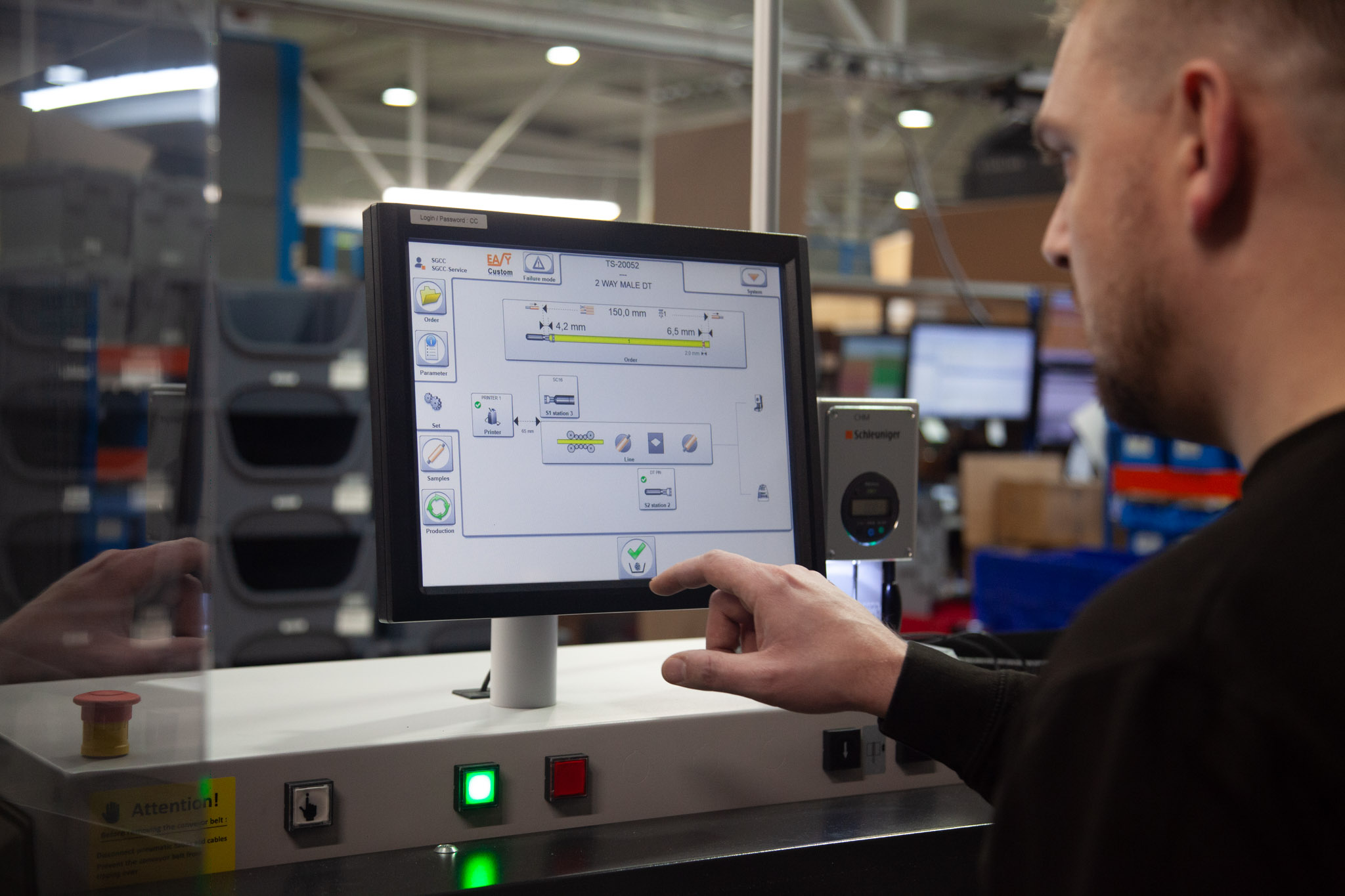
Measure continuity end to end with a DMM, targeting low resistance consistent with conductor length and gauge, and log the reading. Verify polarity and function at the last device by simulating the intended signal and observing the controller or indicator response. If the branch includes an AFCI, press the test button to confirm trip and reset behavior. For throughput and repeatability, automated stations can verify pin position and depth at high speed, as demonstrated by connector inspection cells that reach about 120 parts per minute with micrometer accuracy in this electrical connector vision inspection case study. Treat this as final end-of-line testing that provides system-level confidence.
Record observations and anomalies for review
Capture each check in a digital log, including device IDs, torque values, measured resistance, photos of critical terminations, and operator sign off. Assign a serial or lot number to the wiring assembly for traceability and service. Categorize defects such as crimp height out of tolerance, wrong wire ID, or insulation damage, and open rework tickets immediately. AI assisted end-of-line platforms can attach annotated images and pass or fail reports to every build, as illustrated in this example of AI visual inspection for EOL quality control. The expected outcome is a clear pass or fail record, faster troubleshooting, and consistent quality at scale.
Tips and Troubleshooting for Common Issues
Address loose connections promptly
Prerequisites and materials: updated schematics, calibrated torque driver, pull-gauge capable of 50 N, multimeter, insulation resistance tester, magnifier, and clean swabs. For end of line wiring, start with a visual review of every termination, looking for corrosion products, incomplete ferrule insertion, or set-screw witness marks that do not align with conductor strands. Step 1, perform a targeted pull check on critical crimps, apply 50 N for 10 seconds, any movement exceeding 2 mm indicates a re-crimp is required. Step 2, verify torque at field and panel terminals against the terminal schedule, then record the value to your digital checklist for traceability. Step 3, confirm electrical integrity, continuity should be stable with no intermittent drops and insulation resistance should meet the assembly specification before energization. For structured walk-throughs, consult this concise wiring inspection and troubleshooting procedure.
Identify and resolve wiring harness defects
Materials: harness print, routing map, non-marring clamps, edge protection, and a millimeter-scale ruler. Step 1, verify routing, harnesses should avoid sharp edges and moving members, use grommets and clamps with adequate bend radius and maintain consistent support intervals to prevent abrasion. Step 2, confirm connector fit, housings must fully seat with latches engaged and no visible gap; back-shells should not rotate after tightening. Step 3, assess damage, inspect for cuts, cracked insulation, or flattened sections, then measure conductor resistance end to end, a typical short-run control conductor should read under 0.5 ohm, investigate anything higher. Document rework with lot and cavity IDs so repeated faults can be traced to a tool, die, or station. Align labeling and segregation with current code editions for clear servicing and faster fault isolation.
Utilize predictive analytics for advanced troubleshooting
Materials: temperature stickers or RTDs on terminals, current sensors, a data logger, and analytics software. Step 1, collect baseline data during final functional verification, record terminal temperature, current, and voltage drop at 1 Hz so later deviations are measurable. Step 2, set thresholds and trends, for example, flag a 15 percent rise in contact temperature or a steady increase in milliohm drop across a terminal over several cycles. Step 3, use models to forecast maintenance, even simple regressions can signal drift; advanced approaches, such as physics-informed recurrent neural networks, help detect fatigue-related patterns in connectors. Convert insights into action by scheduling re-torque, re-crimp, or connector replacement before a fault surfaces. This approach improves reliability and shortens future troubleshooting.
Why Choose Tec-Stop for Your Wiring Solutions?
Reliable end-of-line wiring
Selecting Tec-Stop for end of line wiring gives you dependable assemblies backed by measured process control. We align each build to clear schematics, controlled torque values, and verified ferrule and terminal selections, which reduces rework and speeds troubleshooting. Every harness and control panel assembly is validated with end-of-line testing that confirms continuity, polarity, insulation resistance, and functional I/O before shipment. Designs are prepared against current codes and standards, including readiness for the 2026 National Electrical Code reorganization for North American projects, and IEC or BS EN guidance for UK and EU deployments. Where the application requires it, we specify Arc Fault Circuit Interrupter protection to enhance fire safety.
Step-by-step engagement and expected outcomes
For beginner teams, our trained specialists guide each stage with calm, clear communication and ISO 9001 process control. Prerequisites are simple, provide finalized schematics, load data, enclosure size, and any environmental constraints such as temperature or ingress rating. Materials we commonly specify include UL or BS EN rated wire, ferrules, heat-shrink, labeled terminals, and calibrated tools like torque drivers and crimp-force monitored presses. Since 2022 we have converted approximately 450 miles of wire and 52,542 components into 651 finished products, supporting a 21.7 percent year-over-year growth while maintaining consistent quality. The outcome for you is a labeled, tested assembly with traceability records, pass and fail limits, and an installation guide aligned to your production sequence.
Scope and design review, confirm schematics, code targets, test points, and acceptance criteria.
Preparation, cut lists, load boards, sample crimps with pull testing, torque plan, label schema.
Assembly, automated strip and crimp, ferrules, routed with clamps, power-control segregation, AFCI-ready layout.
End-of-line testing and sign-off, continuity, insulation resistance or hipot, functional I/O, digital records.
Conclusion: Achieving Excellence in End-of-Line Wiring
Excellence in end of line wiring relies on disciplined repetition, clear documentation, and final verification. Apply a consistent termination sequence, strip, crimp, inspect, label, and log, because repeatable control improves field reliability and speeds troubleshooting. Align each assembly with the reorganized 2026 National Electrical Code by recording how wiring methods and protection choices satisfy the applicable articles. Incorporate end of line testing that proves continuity, polarity, insulation resistance, and functional I/O, this delivers system level verification before shipment. Where circuits need enhanced protection, specify Arc Fault Circuit Interrupters to reduce fire risk and protect people and equipment.
Standardize work instructions with visual acceptability criteria and train to those visuals, then audit outcomes weekly. 2. Track simple end of line metrics, first pass yield, continuity ranges, insulation resistance thresholds, and react the same day when a reading falls outside limits. 3. Review code and safety quarterly, map the build to the 2026 NEC structure, and validate where AFCI protection and labeling are required. As electrification grows and AI driven quoting accelerates change in wire harnesses, maintain change control so drawings, routings, and assemblies stay synchronized. Tec-Stop can translate these practices into dependable wiring solutions, applying automated termination and smart EOL fixtures to improve performance, safety, and confidence in every connection.