A reliable wiring loom can make or break product performance, uptime, and compliance. Yet not all wiring loom makers are created equal. Choosing the right partner is a strategic decision that affects cost, lead time, maintainability, and long term scalability. If you are past the basics and ready to refine your vendor roster, this guide will help you compare suppliers with confidence.
In the pages ahead, you will get a clear framework for evaluating wiring loom makers across capabilities, quality credentials, and engineering support. We will break down manufacturing technologies such as automated cut and strip, crimp validation, overmolding, and braiding. You will learn how to assess testing regimes, from continuity and hipot to environmental screening. We will also cover certifications and standards, including ISO, UL, and IPC/WHMA A 620 classes. Expect practical guidance on quoting and total cost, including MOQs, tooling, first article approval, and documentation. You will see when to choose a specialist prototype house versus a high volume contract manufacturer, and how industry fit differs for automotive, aerospace, industrial, and medical applications. By the end, you will have a concise checklist to select the right maker for your requirements.
Understanding the Criteria for Comparison
Core selection factors
Comparing wiring loom makers starts with materials, geometry, and environmental fit for your wiring solutions. Seek conductor and insulation choices that balance conductivity, temperature rating, and durability, for example lightweight PA12 or TPU jackets documented by industrial wiring loom selection. Aerospace and mobile equipment demand vibration resilience, while EV platforms add high voltage creepage and clearance requirements; resources on selecting the right wires and cables outline these tradeoffs. Confirm certifications such as ISO 9001 and IPC/WHMA-A-620, plus evidence of custom routing, strain relief, and connector sealing matched to your long-term duty cycle.
Performance and reliability benchmarks
Performance and reliability hinge on engineering detail in drawings and test plans. Compare shielding strategies, ground schemes, and impedance control for data pairs; review pull-test values, crimp-force monitoring, and 100 percent continuity plus hipot for HV assemblies. Robust makers document design FMEAs and maintain first pass yield above 98 percent with low ppm field defects once builds stabilize. Digital twin and simulation practices, described in advancing technology in wire harness manufacturing, help validate bend radii before release. Ask for traceable lot data on wire, terminals, and seals to support quick root cause if an issue arises.
Automation and technology maturity
Automation and technology maturity influence cost, lead time, and consistency as volumes scale. Evaluate whether cutting, stripping, and crimping run on monitored equipment, whether vision systems and AI flag mispins or nicked strands, and whether BOM extraction uses structured data. Semi-automated builds reduce human error and shorten takt time; robotics are compelling on repeatable subassemblies. Capturing crimp metrics, torque data, and in-process checks builds a digital thread for audits and fast engineering changes. With the wire harness market rising from 74.9 billion dollars in 2024 toward 120.2 billion by 2033, flexible automation positions OEM programs for predictable ramps.
Role of Automation and Efficiency
How automation lifts throughput and consistency
Automation reshapes how wiring loom makers deliver throughput, repeatability, and traceability. Compared with purely manual builds, semi-automated cut, strip, and crimp lines shorten takt time, standardize terminations, and reduce rework driven by measurement or handling variation. Fully automated cells extend those gains with in-line verification and serialized trace data, which helps compress lead times on repeat assemblies while improving first pass yield. Digital work instructions and automated testers add closed-loop feedback so defects are caught at source rather than at end-of-line audit. These practices align with industry findings on the impact of automation and robotics in wire harness assembly.
Tec-Stop practices that drive efficient builds
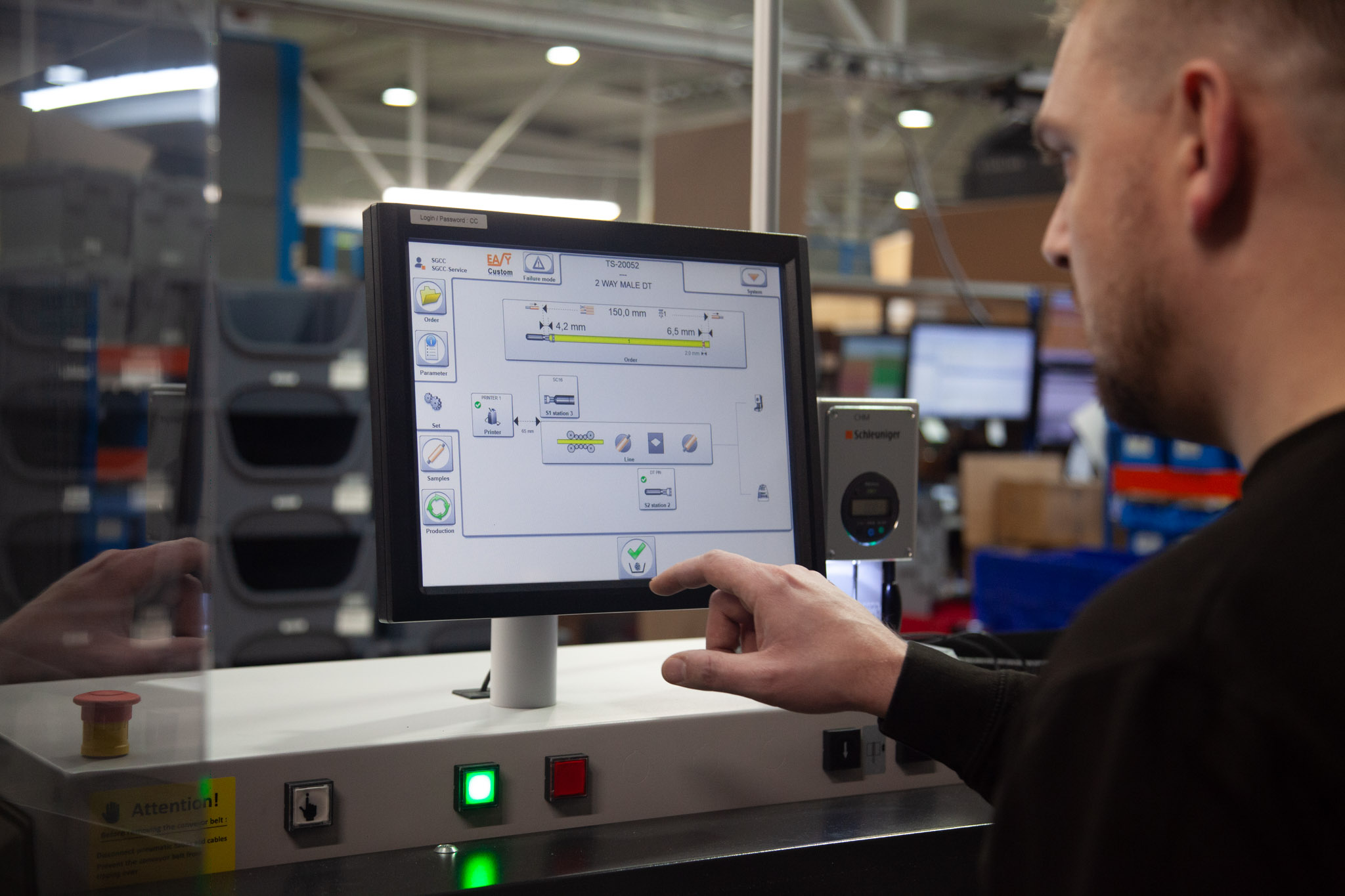
At Tec-Stop, we combine semi-automated cut-strip-crimp equipment with laser stripping for fine gauges and high-temperature insulation. Crimp force monitoring, pull-force sampling, and SPC dashboards keep Cpk on critical terminations at or above 1.67 for statistically capable results. Barcode-driven travelers, pick-to-light kitting, and in-line label and inkjet marking remove manual lookups and prevent part swaps. Automated continuity and hipot tests run at the harness board, then again at final, so issues never advance to the next operation. For complex routing, we use digital twin layouts to optimize harness boards and reduce change cycles, which shortens build times on recurring assemblies and improves material utilization.
Robotics and error reduction
Collaborative robots assist with connector insertion, wire routing, and heat-shrink placement, applying consistent force and alignment that human repetition cannot maintain over long runs. Vision guidance confirms terminal presence, orientation, and seal position, and force sensors flag out-of-window insertions in real time. This combination reduces common defects such as bent tabs, partial crimps, and nicked conductors, and it raises first pass yield on multi-connector looms. Automated testers execute continuity, insulation resistance, and high-voltage checks swiftly across hundreds of circuits, without slowing takt. Results are logged per serial number, giving OEMs traceable proof of conformance.
Choosing the right level of automation
Low volume, high mix: prioritize modular cells, digital work instructions, quick-change tooling, and early test access.
Mid volume: add cobots, crimp force monitoring, and vision checks to improve yield without sacrificing flexibility.
High volume or EV-scale harnesses: look for fully integrated cells with in-line test, full serialization, and digital twin workflows.
Ask for measurable data, including Cpk on critical crimps, first pass yield by family, and serialized test records.
Material Innovations in Modern Wiring Looms
Lightweight and eco‑friendly material options
Wiring loom makers are shifting from PVC toward lighter, cleaner polymers that maintain toughness under higher thermal loads. Thermoplastic elastomers offer rubber‑like flexibility with recyclability, typically serving temperature classes up to 125 C, which suits cockpit looms and consumer devices. Cross‑linked polyethylene provides excellent heat aging and dielectric strength for EV high voltage runs and engine bay zones, often rated 90 to 150 C depending on formulation. Polypropylene blends reduce mass and can deliver good abrasion resistance, although cold‑temperature brittleness must be managed with elastomer modifiers. Bio‑based plastics are emerging for jackets and sleeves, cutting embodied carbon with comparable mechanicals to fossil plastics. For a concise overview of halogen‑free and recyclable options, see this primer on eco‑friendly and halogen‑free cable material trends.
Performance and sustainability, trade‑offs that matter
Material selection directly affects reliability, build efficiency, and environmental impact. XLPE’s higher thermal headroom supports tighter routing near heat sources, which can shorten harness length and reduce copper usage. TPE helps with fast layup and rework due to bend recovery, improving takt time in semi‑automated assemblies. Recyclable TPE and PP blends aid closed‑loop waste programs, while bio‑based TPU sheaths have been reported to deliver roughly a 24 percent lower carbon footprint compared with fossil‑based equivalents. Consider trade‑offs carefully, for example, XLPE’s cross‑linking improves heat life, but recyclability pathways are more limited than pure thermoplastics. For lightweighting targets, thin‑wall PP or TPE jackets combined with optimized conductor gauges typically provide the best mass reduction per dollar.
Tec‑Stop’s approach to cutting‑edge materials
Tec‑Stop evaluates materials through a comparative matrix that balances thermal class, abrasion performance, bend radius, halogen‑free compliance, and recycling potential. We qualify XLPE for high‑load zones and select TPE or PP blends where repeated flex, cable tray densities, and weight budgets drive the design. Our wiring solutions emphasize durability and maintainability, validated with heat aging, flex, and flammability testing, coupled with terminal corrosion and pull tests for long‑life assemblies. Sustainability extends beyond polymers, we use cut‑to‑length processing to minimize scrap, recycle copper offcuts, run assembly lines on solar power, and ship in fully recyclable packaging. For OEMs, our recommendation is simple, pair material choice to duty cycle and environment, then validate on your geometry using accelerated tests before committing the loom to production.
Technological Advancements in Wiring Looms
AI-driven design and production
AI is reshaping how wiring loom makers design and build assemblies, and it offers clear choices. Rule-based CAD templates help enforce constraints, yet they struggle with variant complexity. AI-assisted routing, as profiled in Integrating AI in Wiring Harness Design for Enhanced Efficiency, learns from historical layouts to propose optimized paths and BOMs, cutting iteration time and rework. On the floor, AI motion planning for assembly robots, demonstrated in Yazaki and NEC Use AI to Control Wire Harness Assembly Robots, removes lengthy teach-ins and has shown about 10 percent cycle time gains. For quality control, AI-driven inspection, such as A Fault Detection System for Wiring Harness Manufacturing Using Artificial Intelligence, detects pattern anomalies early, reducing manual checks and scrap.
IoT-enabled functionality
IoT adds intelligence to wiring solutions, but there are multiple approaches. Embedded in-harness sensors and microcontrollers enable continuous continuity, temperature, and vibration monitoring, which suits high duty EV and off-highway applications. Connector-level smart tags are lighter and cheaper, yet they mainly support identity, torque verification, and service history rather than live telemetry. An edge node outside the loom aggregates data from multiple assemblies, lowering harness weight but increasing dependency on network availability and gateways. For mixed fleets, plan a minimal common data model, sample at rates aligned to failure modes, and budget power carefully to avoid parasitic drains during key-off states.
Standards for consistent performance
Standards turn these technologies into consistent performance. For build quality, specify IPC/WHMA-A-620 with the correct class, then define measurable acceptance, for example crimp height Cpk above 1.33, 100 percent continuity test, and insulation resistance thresholds suited to operating voltage. For interoperability, align IoT telemetry with W3C Web of Things semantics or publish a stable schema to prevent vendor lock-in and ease cross-platform analytics. In safety-critical applications, require configuration control, serialized traceability, and process FMEAs tied to test coverage. As harness complexity grows alongside a market projected to rise from 74.88 billion in 2024 to 120.21 billion by 2033, disciplined standards are the lever that keeps risk low.
Geographical Variations in Wiring Loom Manufacturing
Regional technology adoption patterns
Wiring loom makers do not adopt technology at the same pace worldwide, and the differences are shaping pricing, lead times, and achievable quality levels. Asia Pacific pushes high throughput with extensive use of automated cutting, crimp-force monitoring, and robotic taping, driven by EV volume; China’s multi‑million unit EV output in 2023 pulled through demand for high‑voltage harnesses with tighter bend radii and improved shielding. North America leans into Industry 4.0, with digital work instructions, serialised traceability, and AI assisted quoting and BOM extraction reducing NPI cycle time. Europe advances sustainability, prioritising recyclable polymers, low‑halogen insulation, and energy efficient equipment to meet regulatory targets. In the Middle East and Africa, capability is expanding, with growing use of semi‑automation and modular subassemblies to support commercial vehicles and infrastructure. For OEMs, the practical impact is clear: region dictates the default mix of automation, sustainability features, and documentation depth.
Local priorities and what they mean for sourcing
Regional priorities carry trade offs that should inform your sourcing brief. Asia Pacific’s scale offers compelling unit cost, although you should specify objective quality gates, for example 100 percent continuity test, crimp height SPC, and documented pull‑force sampling, to maintain consistency at speed. North America supports high mix, low to mid volume programs that require custom overmoulds, sealed interconnects, and configuration control, at higher landed cost but shorter NPI iterations. Europe can deliver lighter, eco focused wiring solutions using TPEs and recyclable sleeving; factor in slightly longer qualification to validate new materials and end of life plans. Middle East and Africa provide regional proximity for certain platforms; pair with detailed PFMEAs and clear IP67 or IP69K sealing criteria to de risk first articles. Across regions, ask for IPC/WHMA‑A‑620 workmanship, documented torque settings, and measured insertion and extraction forces to protect reliability.
Tec-Stop’s position and guidance for OEMs
Tec-Stop focuses on bespoke wiring solutions and control panel assemblies where reliability, traceability, and clean communication matter most. Built on ISO 9001 processes, we apply semi‑automation, crimp force monitoring, and 100 percent electrical test to deliver consistent results for EV subsystems, agricultural platforms, marine refits, and industrial equipment. Our sweet spot is high mix and safety critical harnesses, including sealed branches, compact routing, and modular breakouts that simplify service. For pre‑production and regional builds in the UK and Europe, Tec-Stop provides rapid NPI, clear DFM feedback, and stable repeatability. When volumes climb, we coordinate with qualified partners while retaining design control, test coverage, and serialised documentation. Recommendation: use Tec-Stop for complex prototypes and mid volumes, specify quantitative test metrics up front, and lock a material set that balances weight, thermal rating, and recyclability.
Expert Recommendations and Practical Solutions
Guide to selecting the right wiring loom maker
Start with the application’s operating profile, then map it to capabilities. Define conductor size ranges, thermal envelope, chemical exposure, ingress targets, and any high‑voltage or data‑rate constraints, then ask wiring loom makers to show documented capability against each item. Request certifications and process evidence, for example ISO 9001, operator training matrices, calibrated tooling logs, and test coverage that includes continuity, hipot where relevant, and pull‑force sampling. For new product introduction, ask for PPAP or a first article pack with drawings, ballooned characteristics, and measurement reports. Check scalability by reviewing takt time studies and cell layouts that show how the line expands from pilot to volume. A brief supplier audit focusing on traceability, rework controls, and serialization will usually surface strengths and risks quickly.
Pros and cons of top industry approaches
Standardized looms suit stable, high‑volume programs, offering predictable pricing and shorter changeover; the tradeoff is limited geometry and connector choice. Custom looms enable tight packaging, mixed signal integrity, and unique fasteners, but they add engineering time and require robust change control. In‑house builds provide direct oversight and easy design iteration, yet they demand capital equipment, skilled technicians, and ongoing quality management. Outsourcing to specialists brings automated cutting, crimp validation, and fixture libraries that reduce human error, though it requires disciplined communication and clear revision control. For programs facing EV‑level complexity and higher integration, modular subassemblies with standardized branch interfaces can balance customization with serviceability, supporting faster maintenance and line replacement.
Why Tec‑Stop’s solutions offer a strategic advantage
Market complexity is rising, with the wire harness sector growing from USD 74.88 billion in 2024 toward USD 120.21 billion by 2033, so dependable partners matter. Tec‑Stop aligns engineering with production reality, combining custom harness design, controlled assembly, and test plans that match the environment and duty cycle. Our teams use structured DFM reviews, AI‑assisted quoting and BOM extraction for speed and accuracy, and automated cut, strip, and crimp with in‑process validation for consistency. We support sustainability targets through thoughtful material selection and packaging practices that reduce waste without compromising reliability. For OEMs, the result is clear traceability, predictable lead times, and assemblies that install cleanly, perform reliably, and scale with demand.
Conclusion
Recap and market context
Across our comparisons, the best outcomes came from semi automated builds paired with rigorous quality controls, with fully automated cells reserved for stable, high volume parts. Lightweight, halogen free polymers trimmed mass and heat load, while PVC remained viable for benign, cost sensitive installations. AI assisted quoting and BOM extraction sped NPI when data was structured, yet manual reviews still protected safety critical interfaces. Electrification is raising loom complexity, and the market is forecast to grow from 74.88 billion USD in 2024 to 120.21 billion USD by 2033 Wire Harness Market size. For deeper context, review EV driven harness complexity in Top 10 Electrical Wire Harness Market Trends to Watch in 2026.
Actionable next steps and Tec-Stop’s commitment
To choose wiring loom makers, define electrical envelope, thermal range, ingress risks, and routing space, then request sample assemblies with IPC/WHMA-A-620 Class 2 or 3 evidence. Ask for crimp capability studies with Cpk above 1.33 on height and pull force, serialization that links test data to each assembly, and documented error proofing at stations. Pilot 20 to 30 units to compare first pass yield, takt adherence, and whether AI quoting returns accurate BOMs without corrections. Specify halogen free or recycled content, confirm UL flammability ratings, and model weight deltas against mass budgets. Finally, score communication cadence and change control. Tec-Stop delivers reliable wiring solutions and control panel assemblies with clear documentation, consistent workmanship, and practical engineering that gives OEMs confidence in every connection.